
Implied Probability: How Odds Convert Into Value—or Negative Value
A beginner-friendly guide to converting decimal betting odds into implied probability, comparing that probability with a model estimate, and recognising positive and negative value.
Introduction: Odds Are Prices, Not Predictions You Must Accept
Decimal odds are prices. They tell you the return attached to a successful one-unit stake, and they can be converted into the win rate required to break even over many comparable bets. That break-even rate is called implied probability.
Implied Probability in Plain English
Implied probability is the probability built into an available price. In practical terms, it is the approximate success rate a bettor would need at that price to break even before fees and real-world constraints such as limits or unavailable stakes.
It is not a statement of certainty. Nor is it necessarily your view of the event. Your own estimate—or a model estimate—is a separate input. The useful comparison is between that independent estimate and the probability implied by the price.
The Core Conversion: Decimal Odds to Implied Probability
For decimal odds, use this formula:
For example, decimal odds of 2.00 imply a 50% break-even probability: (1 ÷ 2.00) × 100 = 50%. Lower decimal odds imply a higher break-even probability. Higher decimal odds imply a lower break-even probability.
Convert Probability Back Into Fair Decimal Odds
The reverse calculation turns a probability estimate into fair decimal odds—the break-even price for that estimate.
If an independent assessment gives a selection a 40% chance, write that as 0.40. Fair odds are 1 ÷ 0.40 = 2.50. This does not predict what will happen in one match. It identifies the price at which that 40% estimate would be break-even in theory.
Quick Decimal Odds Conversion Table
| Decimal odds | Calculation | Implied probability |
|---|---|---|
| 1.50 | 1 ÷ 1.50 × 100 | 66.67% |
| 1.80 | 1 ÷ 1.80 × 100 | 55.56% |
| 2.00 | 1 ÷ 2.00 × 100 | 50.00% |
| 2.50 | 1 ÷ 2.50 × 100 | 40.00% |
| 3.00 | 1 ÷ 3.00 × 100 | 33.33% |
| 4.00 | 1 ÷ 4.00 × 100 | 25.00% |
What “Value” Means: Compare Your Probability With the Price
Positive value exists in theory when an independently derived probability estimate is higher than the probability implied by the available odds. In other words, the available price is longer than the fair price produced by your estimate.
Negative value is the opposite: your estimated probability is lower than the odds-implied probability. The price is shorter than your fair price. This comparison is only as useful as the estimate behind it. A model percentage is not automatically correct; it should be documented, tested and assessed for calibration.
Two Worked Examples: Positive Value and Negative Value
Consider the same hypothetical available odds in both examples: 2.50. The implied probability is 40%. For a one-unit stake, a compact expected-value expression is: EV = (estimated probability × decimal odds) − 1. The result is the theoretical long-run expectation per unit staked, not a promised return.
| Available odds | Implied probability | Estimated probability | EV calculation | Interpretation |
|---|---|---|---|---|
| 2.50 | 40% | 45% | (0.45 × 2.50) − 1 = +0.125 | Positive value in theory |
| 2.50 | 40% | 35% | (0.35 × 2.50) − 1 = −0.125 | Negative value in theory |
Why a Negative-Value Bet Can Win—and a Value Bet Can Lose
Probability describes uncertainty, not a guaranteed sequence of results. A selection estimated at 40% can win in one trial. A selection estimated at 60% can lose in one trial. The result answers whether that one event happened; it does not, by itself, establish whether the price was favourable.
Bookmaker Margin: Why a Whole Market Can Add Up to More Than 100%
In a standard fixed-odds market with several outcomes, the raw implied probabilities can add up to more than 100%. This excess is commonly called the overround or bookmaker margin.
| Outcome | Illustrative odds | Raw implied probability |
|---|---|---|
| Home win | 2.00 | 50.00% |
| Draw | 4.00 | 25.00% |
| Away win | 3.70 | 27.03% |
| Total | 102.03% |
A no-margin probability is a separate market-normalisation exercise. Do not confuse it with the simpler question of whether your own estimate exceeds the probability implied by the price actually available to you.
How This Maps to the Site’s Value Bets Board
The site’s Value Bets board displays fields including Probability, Implied Odds, Bookmaker, Latest Odds and Value, alongside fixture, market and Predictability information. Read those fields as a research framework: a probability can be translated into a fair price, then compared with the latest quoted price for the specified market and bookmaker.
From Raw Board to Research Workflow: Filtering and Backtesting
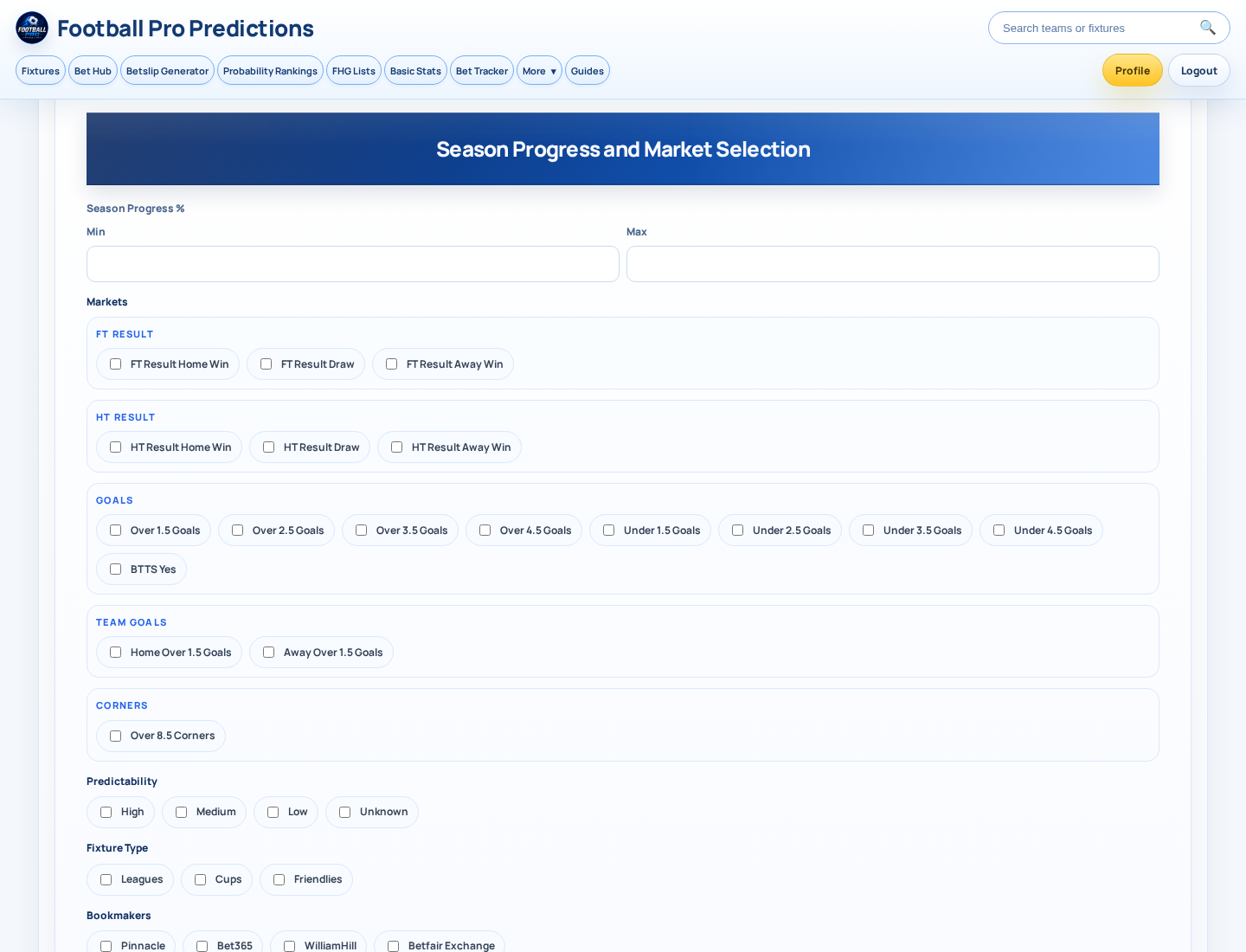
Filtered Value Bets provides controls for probability, odds, value, season progress, markets, predictability, fixture type and bookmakers. It also displays an option labelled “Only use odds that have not dropped below opening.” The interface supports using these controls to narrow a broader board into shortlist profiles; its intended analytical interpretation should be confirmed in the product methodology.
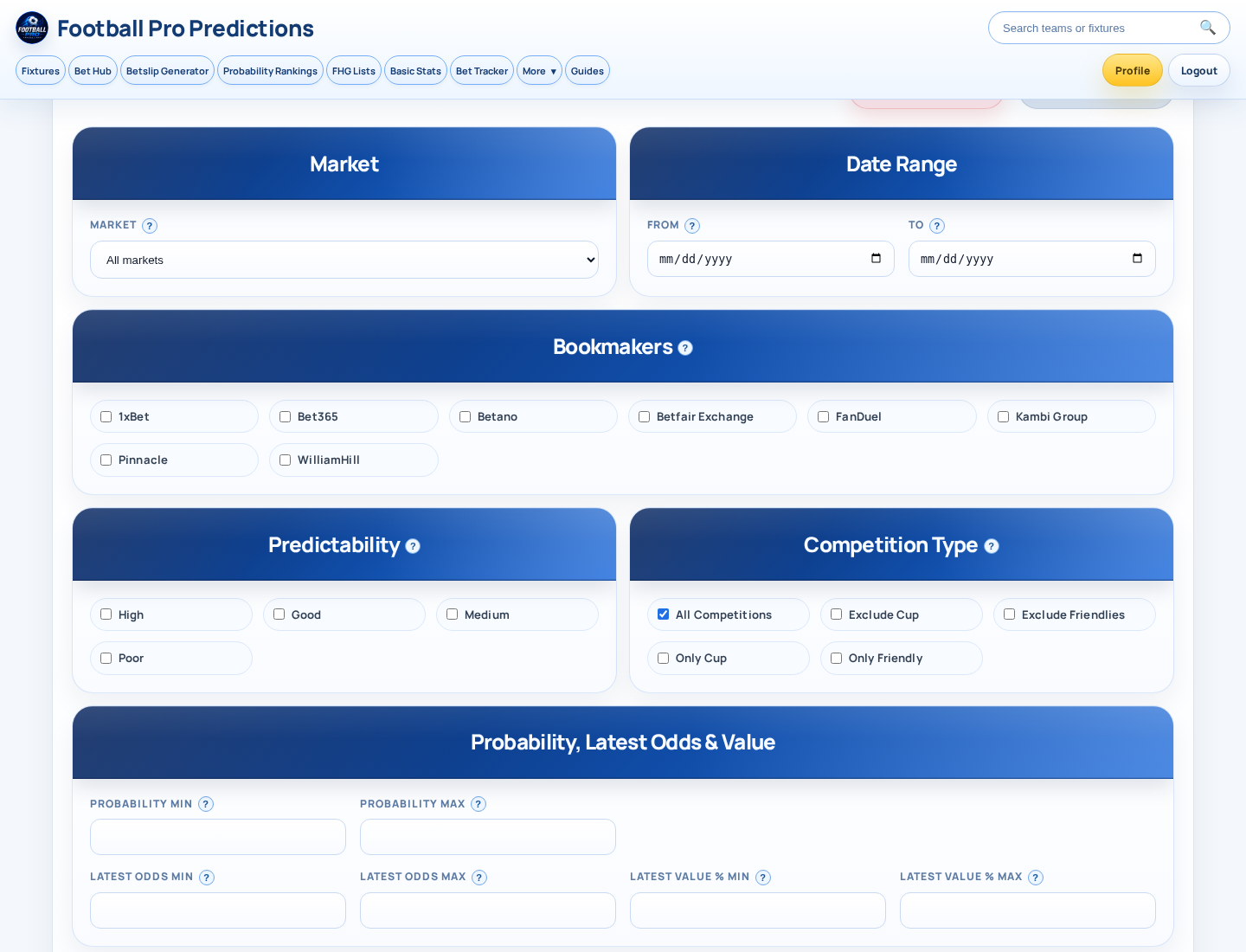
Value Bets Backtesting is presented as a settled archive with filters for market, date range, bookmaker, predictability, competition type, probability, latest odds, latest value, opening odds, opening value and competition progress. Historical testing can help examine a defined process, but it does not establish future returns. Results may depend on filter choices, sample selection, price availability, settlement conventions and changing conditions.
Beginner Checklist Before Calling Anything “Value”
Key takeaways
- Confirm the exact market and selection.
- Record the available decimal odds, bookmaker and timestamp.
- Calculate the odds-implied probability.
- Create an independent, documented probability estimate.
- Compare the estimate with the price-implied probability.
- Account for relevant fees, market rules and practical stake constraints.
- Check that the displayed price is genuinely available at the intended stake.
- Do not treat a short run of results as validation.
- Use conservative, pre-set bankroll limits.
Common Errors and How to Avoid Them
| Error | Correction |
|---|---|
| Mixing percentages and decimals | Use 0.40, not 40, in the fair-odds and EV formulas. |
| Treating odds as your forecast | Use odds to find the break-even probability; form a separate estimate. |
| Confusing fair odds with offered odds | Fair odds come from your estimate. Offered odds are the available market price. |
| Ignoring market margin | Remember that implied probabilities across a market can exceed 100%. |
| Calling a bet value because it won | Judge value from price and estimate before the outcome, not from the result. |
| Trusting an unverified percentage | Document and evaluate the method that produced the estimate. |
| Using stale or unavailable odds | Record the actual price available when a decision is made. |
Key Takeaways
Key takeaways
- Convert decimal odds into implied probability with (1 ÷ odds) × 100.
- Convert a probability estimate into fair decimal odds with 1 ÷ probability as a decimal.
- Positive value in theory means your estimate is higher than the price-implied probability.
- Positive or negative value does not determine the outcome of one bet.
- Treat value boards, filters and backtests as research tools, not guarantees.
Frequently asked questions
What does 2.00 mean in implied probability?
Decimal odds of 2.00 imply a 50% break-even probability: 1 ÷ 2.00 = 0.50, or 50%.
Are implied probability and true probability the same?
No. Implied probability is derived from the available price. A true or independently estimated probability is a separate judgement, and market margin can affect raw price-implied probabilities.
Can a bet be value and lose?
Yes. Positive value is a statement about the relationship between estimated probability and price, not a guarantee that one event will win.
Can a negative-value bet win?
Yes. A negative-value selection can still win as a one-off outcome. Its price is considered unfavourable only relative to the stated probability estimate.
Why do probabilities in a market exceed 100%?
In many fixed-odds markets, adding the raw implied probabilities produces more than 100%. The excess is the overround, or bookmaker margin.
Does a positive Value percentage guarantee profit?
No. It does not guarantee a winning result or future profit. Before interpreting a platform-specific Value percentage, confirm the product’s formula, rounding and any fee treatment.
Related Guides and Source Notes
Continue your research in Value Bets (/value-bets), Filtered Value Bets (/filtered-value-bets) and Value Bets Backtesting (/value-bets-backtesting). Product descriptions in this guide are based on the visible controls and warnings supplied for those first-party pages. Live rows and prices are not used as enduring examples because they can change. Mathematical examples above are transparent arithmetic using hypothetical odds and estimates.

Sources and further reading
- Value Bets — Football Pro Predictions
- Filtered Value Bets — Football Pro Predictions
- Value Bets Backtesting — Football Pro Predictions
Put This Guide Into Practice
Use the live research tools to compare upcoming fixtures, probabilities and available prices. Always check current odds and stake responsibly.