
Football Prediction Bankroll Management: Staking Methods, Kelly Criterion and Bet Tracking
A beginner-friendly guide to separating football predictions from staking decisions, setting a betting bankroll, comparing common staking methods, using Kelly staking cautiously, and recording results in a Bet Tracker.
Predictions Are Not a Staking Plan
A football prediction answers one question: which outcome may be worth considering? A staking plan answers another: how much of your available betting money are you prepared to risk if you place that bet? They should not be treated as the same decision.
No prediction, odds price or staking system guarantees a profit. Bankroll management is a way to set limits, make stake decisions more consistent and create a record that can be reviewed later. It cannot turn poor selections into good ones or remove the possibility of losing money.
Before You Start: Set a Bankroll and Use Units
A betting bankroll is a pre-set amount reserved for betting, not household bills, savings, debt repayments or money needed for day-to-day life. Decide its size before betting rather than changing it in response to a win or loss.
Units make stakes easier to compare. You might define one unit as a fixed cash amount, or as a small percentage of the bankroll. The key is to define the relationship before placing bets and use it consistently. There is no universal unit size that is right for everyone.
For example only, a £100 bankroll with a £1 unit gives you a clear way to describe stakes: 1u means £1, while 2u means £2. If the bankroll is no longer affordable, your circumstances change, or betting is causing pressure, the appropriate response is to reduce or stop—not to deposit more in an attempt to recover losses.
How Odds, Probability and Edge Fit Together
Staking decisions need more than a feeling that a team is likely to win. Decimal odds can be converted into implied probability by dividing 1 by the decimal odds. A bettor may also form an estimated probability from their own analysis. The important comparison is between that estimate and the price available—not confidence alone.
| Term | Meaning | Example only |
|---|---|---|
| Decimal odds | The quoted price, including the returned stake in a winning return. | 2.50 |
| Implied probability | The probability suggested by decimal odds: 1 ÷ odds. | 1 ÷ 2.50 = 40% |
| Estimated probability | Your own assessment of the chance of the outcome. | 45% |
| Edge | The difference between your estimated chance and what the price implies. | 45% estimate versus 40% implied probability |
Probability estimates are uncertain. They can be affected by incomplete information, selective memory and overconfidence. A higher stake should therefore never follow simply because a selection feels especially convincing. Any estimate should be documented and reviewed against a sufficiently complete record over time.
Staking Method 1: Flat Staking
Flat staking means risking the same number of units on every bet that meets your pre-defined criteria. For instance, a flat-staking rule could be 1u per qualifying bet, regardless of recent results, league or personal excitement about the fixture.
Key takeaways
- It keeps exposure consistent and makes records easier to audit.
- It reduces the temptation to increase stakes after a loss.
- It does not make an unprofitable set of selections profitable.
- It can be conservative when you believe some estimates are stronger than others, but that trade-off is often useful while learning.
Staking Method 2: Percentage-of-Bankroll Staking
With percentage-of-bankroll staking, the cash stake changes with the bankroll. A rule might state that each qualifying bet receives a fixed percentage of the current bankroll. This creates smaller cash stakes after losses and larger ones after gains.
For a hypothetical 2% rule, a £100 bankroll produces a £2 stake. If the bankroll later falls to £80, the next stake becomes £1.60. If it rises to £120, the next stake becomes £2.40. The percentage is a risk choice, not a forecast that the next bet will win.
Choose the recalculation schedule in advance. Some people calculate after every settled bet; others recalculate at a fixed weekly or monthly point. Either approach needs a written rule. Switching between them because of a losing run defeats the purpose of having a staking method.
Staking Method 3: Confidence-Based Staking
Confidence-based staking maps defined confidence bands to fixed unit amounts. It can provide a structure where a bettor does not have sufficiently developed probability estimates for a more mathematical approach. However, it is also vulnerable to bias: subjective confidence can rise after a win, fall after a loss, or be influenced by a favourite team.
| Recorded assessment | Pre-defined stake | Rule to protect consistency |
|---|---|---|
| Standard qualifying bet | 1u | Do not alter after placing the bet. |
| Higher-confidence qualifying bet | 1.5u | Use only if the criteria were recorded before the event. |
| Unclear or poorly supported assessment | No bet | Passing is part of a staking plan. |
Confidence is not the same as an accurate probability estimate. Do not raise a confidence rating to justify recovering earlier losses. If confidence bands are used, review whether similarly rated bets were recorded consistently and whether the rationale was complete.
Kelly Staking: A Formula With Strong Assumptions
The Kelly criterion is a stake-sizing formula that uses decimal odds and an estimated probability. In decimal-odds notation, the full-Kelly fraction of bankroll is: ((decimal odds − 1) × estimated probability − (1 − estimated probability)) ÷ (decimal odds − 1).
Here, decimal odds are the offered price and estimated probability is expressed as a decimal, such as 0.45 for 45%. A zero or negative result does not produce a positive-edge Kelly stake; under the formula, that means no stake. The formula is highly dependent on the quality of the probability estimate. If that input is too optimistic, the calculated stake can be too large.
Why Fractional Kelly Is More Appropriate for Many Beginners
Fractional Kelly applies only part of the full-Kelly result. Half-Kelly uses 50% of the calculated figure; quarter-Kelly uses 25%. This lowers exposure when estimates are wrong or outcomes vary, but it does not eliminate loss risk or correct an inaccurate estimate.
For example, if full Kelly suggests an 8% bankroll stake, half-Kelly would be 4% and quarter-Kelly would be 2%. The calculation can look precise, but its result is only as reliable as the probability input. Beginners who cannot explain how they arrived at a probability estimate may be better served by a simple flat-staking rule.
Methods to Avoid: Chasing and Unplanned Stake Changes
A loss does not change the price, probability or quality of the next selection. It only changes the recent balance. Keep the planned rule, lower exposure, or take a break. If betting is causing harm or financial strain, seek support from an appropriate local responsible-gambling service.
Using the Bet Tracker to Create a Betting Record
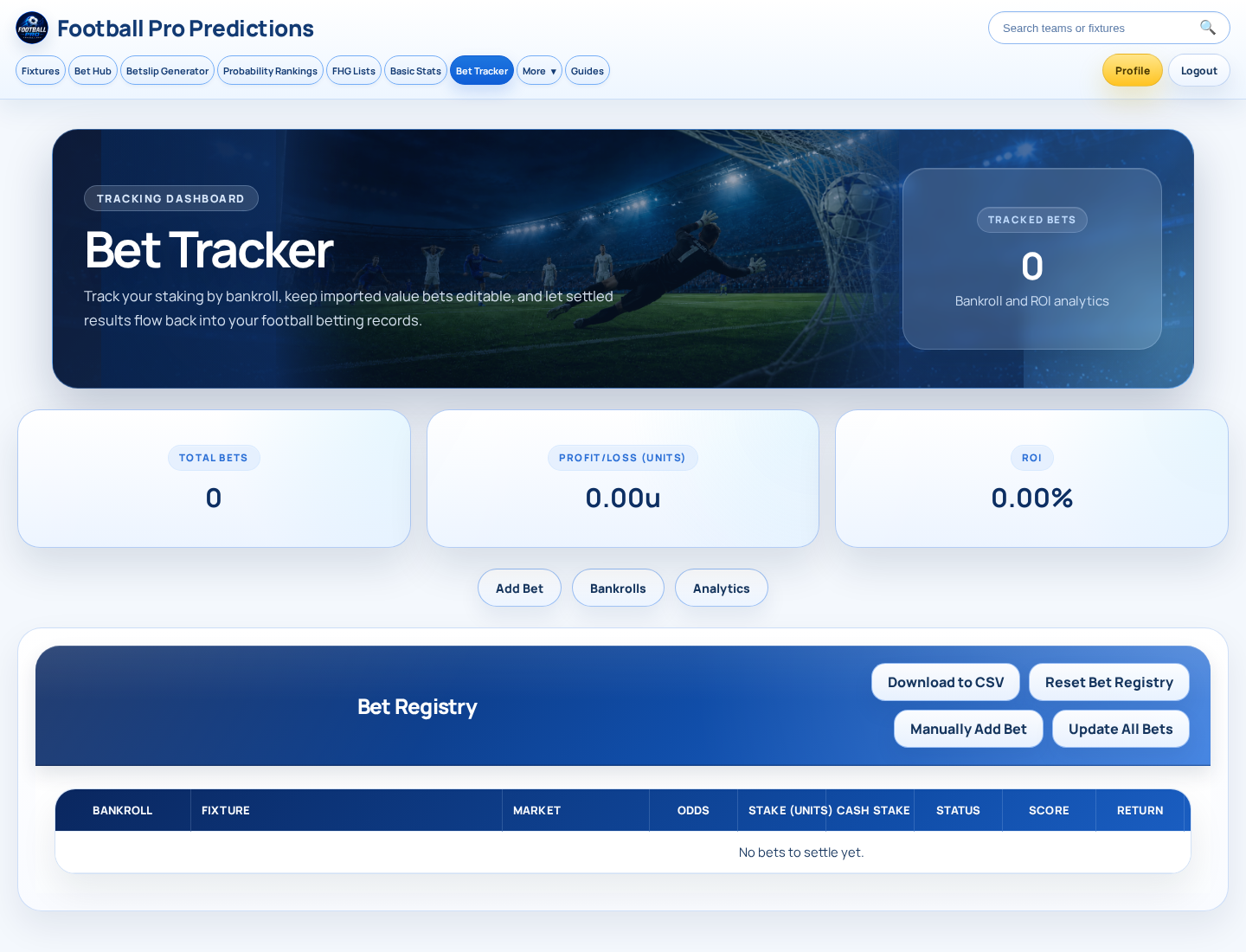
A record makes it easier to see what was actually staked, rather than relying on memory. The [Bet Tracker](/bet-tracker) describes a tracking dashboard for staking by bankroll, editable imported value bets, and settled results flowing back into football betting records.
Its visible dashboard includes tracked bets, total bets, profit/loss in units, ROI, bankroll and ROI analytics, plus a Bet Registry. Available controls shown on the page include Add Bet, Bankrolls, Analytics, Bet Registry, Download to CSV, Reset Bet Registry, Manually Add Bet and Update All Bets.
| Field | Why it is useful to record |
|---|---|
| Bankroll and cash stake | Connects each bet to the money-management plan. |
| Fixture, market and odds | Preserves the original betting context and price. |
| Stake (units) | Tests whether the chosen staking rule was followed. |
| Status, score and return | Keeps the outcome record organised. |
| Profit (units) and cash P/L | Shows results in both unit and cash terms. |
The interface displays ROI, but this draft does not define the product’s ROI calculation, settlement treatment or handling of market-specific outcomes. Confirm those details in product documentation before making claims about them.
A Simple Weekly Bet-Tracking Routine
Where possible, record the bet before the event starts. Check that the odds, stake in units and cash stake match your intended rule. When reviewing, focus on whether records are complete, whether stakes followed the plan, and whether certain markets or odds ranges are being used deliberately. Avoid treating a small number of settled bets as proof that a method works.
Worked Example: One Hypothetical Football Bet, Three Stake Rules
The following is a fictional calculation only. It is not a recommendation to bet on any fixture. Assume a £100 bankroll, where 1u equals £1; fictional decimal odds of 2.50; and an estimated probability of 45% (0.45). The odds imply 40% probability, calculated as 1 ÷ 2.50.
| Method | Calculation | Stake |
|---|---|---|
| Flat staking | Pre-defined 1u rule | 1u (£1) |
| Percentage bankroll | 2% × £100 bankroll | £2 (2u) |
| Full Kelly | ((2.50 − 1) × 0.45 − (1 − 0.45)) ÷ (2.50 − 1) = 0.0833 | 8.33% of bankroll, or about £8.33 |
| Quarter-Kelly | 25% × £8.33 | About £2.08 |
This example shows why Kelly needs caution: the full-Kelly figure is much larger than the flat stake, even though the estimated edge is only as trustworthy as the 45% input. The bet can still lose under every method. A smaller stake changes exposure; it does not change the event’s outcome.
Reviewing Results Without Misreading Them
Profit/loss and ROI are useful record-keeping views, not proof of predictive skill. A positive run can be followed by losses, while a negative run does not automatically identify the cause. Use the record to ask practical questions: Were all bets entered? Were stakes consistent? Are you concentrating on particular markets? Did you obtain the odds you intended to record?
Review on a schedule rather than reacting to every result. A weekly review can be enough to check process adherence. More substantial decisions about a prediction approach should wait for a complete and meaningful record, with the limits of short-run results kept in mind.
Beginner Checklist
Key takeaways
- My bankroll is affordable to lose and separate from essential money.
- I have chosen a unit size and one staking rule.
- I know the stake before the event, and I am not increasing it to recover a loss.
- I have checked the fixture, market, odds and cash stake.
- I have a maximum exposure I am willing to accept.
- I will record the bet in the Bet Tracker and review it later rather than chasing the result.
A disciplined record and a modest, affordable stake can make betting decisions easier to evaluate. They do not promise a return. If gambling stops feeling controlled, affordable or enjoyable, stop and seek appropriate support in your location.
Frequently asked questions
What is a betting unit?
A betting unit is a consistent way to express stake size. For example, if 1u is £1, then a 2u stake is £2. Units help compare bets without tying every discussion to a cash amount.
Is Kelly staking safe?
No staking method is risk-free. Kelly calculations depend heavily on having a realistic probability estimate. Incorrect estimates can create excessive suggested stakes, which is why fractional Kelly is often discussed as a more cautious version.
What happens when the Kelly calculation is negative?
A negative result means the formula does not indicate a positive-edge stake at those odds using that probability estimate. In practical terms, the Kelly stake is zero rather than a negative wager.
Should I change stakes after a loss?
Not simply because of the loss. Follow the rule set in advance, whether that is flat staking or a scheduled percentage-of-bankroll recalculation. Raising stakes to recover losses increases risk.
What does ROI mean in a Bet Tracker?
ROI is commonly used to compare a return or profit measure with the amount staked. The Bet Tracker displays ROI, but its exact calculation should be confirmed in product documentation before relying on a specific formula.
How often should I review my bankroll?
Set a schedule in advance, such as weekly. Check bankroll movement, profit/loss in units, recorded stakes and completeness of entries. Do not let an individual loss dictate an unplanned review or stake increase.
Sources and further reading
- Bet Tracker — Football Pro Predictions
Put This Guide Into Practice
Use the live research tools to compare upcoming fixtures, probabilities and available prices. Always check current odds and stake responsibly.