
How to Use Football Pro Value Bets: Build a Filtered Strategy and Backtest It
A beginner-friendly walkthrough of Football Pro’s Value Bets, Filtered Value Bets and Value Bets Backtesting tools—covering how to turn a raw value feed into a defined, testable betting-research strategy.
Treat Value Bets as Research, Not a Bet List
What You Need Before You Start
You will need access to Football Pro’s [Value Bets](/value-bets), [Filtered Value Bets](/filtered-value-bets) and [Value Bets Backtesting](/value-bets-backtesting) areas. Keep a spreadsheet or other research log alongside the dashboard. If you later choose to place bets, record a fixed research or entertainment budget in advance and use only bookmakers available lawfully to you. The end product of this process is modest but useful: a clearly written filter profile and a historical test of those same rules. It is not proof that the profile will be profitable.
Understand the Four Numbers on a Value Bet
The Value Bets table displays a model **Probability**, **Implied Odds**, **Bookmaker**, **Latest Odds** and **Value**, among other fields. In plain terms, probability is the model’s estimated chance of an outcome; implied odds are the decimal odds corresponding to that estimate; latest odds are the price currently shown for the named bookmaker; and value is Football Pro’s displayed edge measure. For a hypothetical example, a model probability of 40% corresponds to implied decimal odds of 2.50, because 1 ÷ 0.40 = 2.50. If a bookmaker’s latest odds are 3.00, that price is above the model-implied odds. That creates a positive-edge signal under this type of comparison. It does not mean the selection will win, or that the model estimate and quoted price will remain available. Football Pro’s supplied interface text does not document the exact formula behind its displayed Value percentage. Treat the figure as a model-based indicator and verify any methodology details with the product before relying on a specific calculation.
Step 1: Explore the Raw Value Bets Board
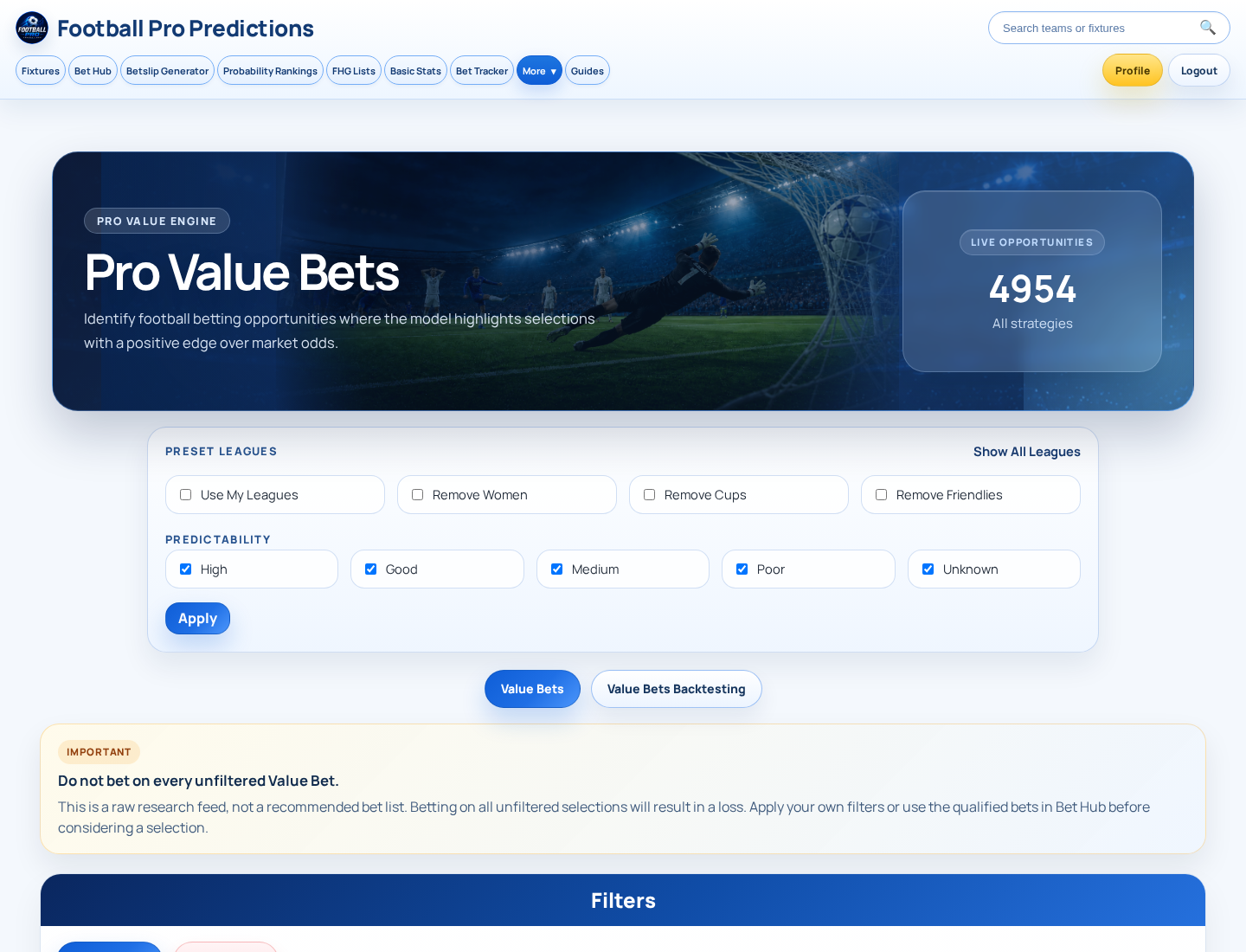
Start on the [Value Bets board](/value-bets) to understand the available universe. The page offers preset-league controls, a personal-leagues option, and options to remove women’s competitions, cups and friendlies. It also displays predictability choices of High, Good, Medium, Poor and Unknown. The table can be scanned by league, predictability, fixture, kickoff time, market, probability, implied odds, bookmaker, latest odds, value and stake, with an option to add an item to the Bet Tracker. Available market types include full-time and half-time results, goal totals, both teams to score, selected team-goal markets and over 8.5 corners. Use this page to observe what is available and to form a hypothesis. Do not mistake a long table of opportunities for a shortlist you should follow without rules.
Step 2: Write the Hypothesis Before You Touch the Results
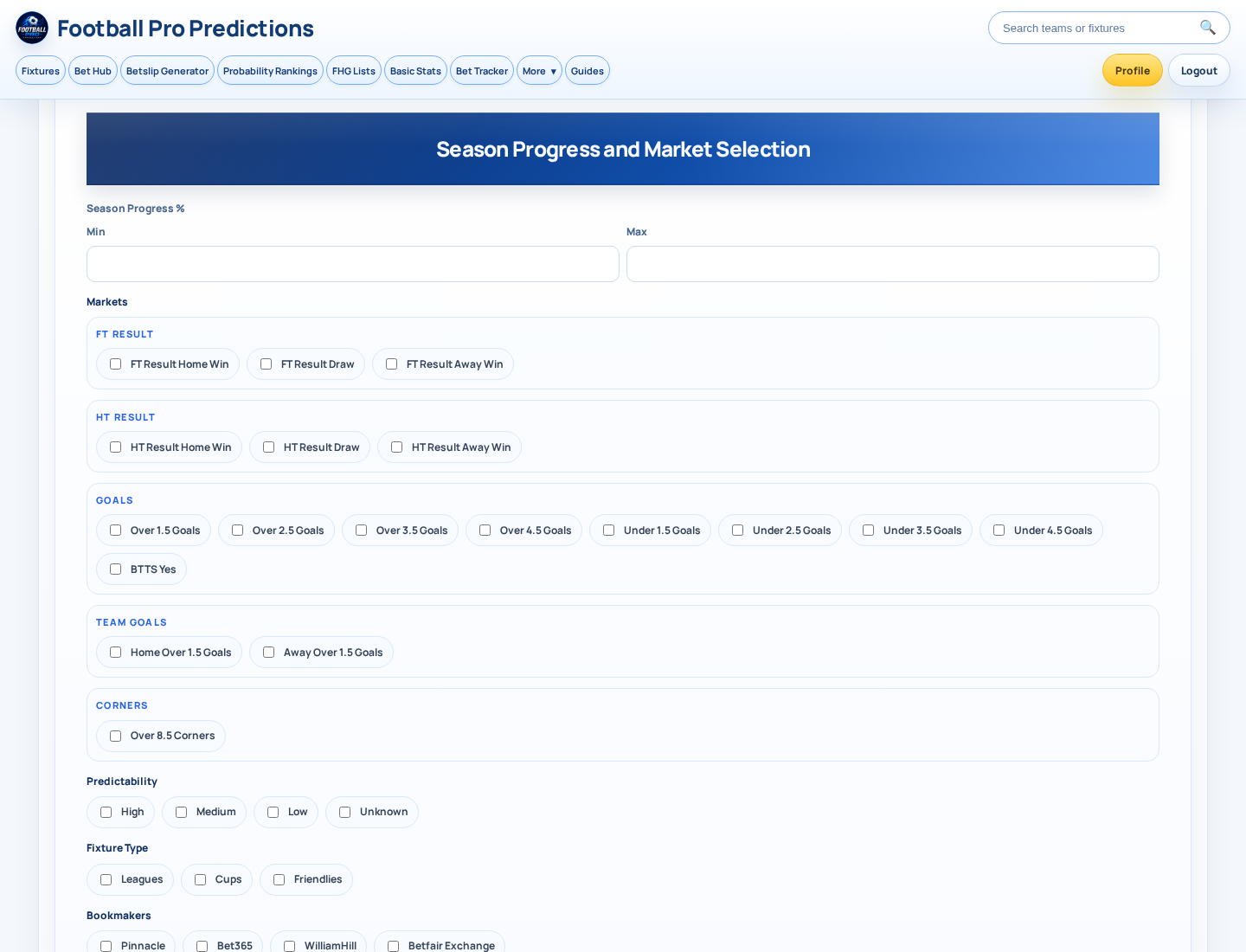
Before creating a filter, write down why each restriction belongs there. A beginner might decide to study only a limited set of markets, a defined competition type and a manageable range of prices. The key is that the rules should exist before you inspect a favourable historical result. Adding conditions simply because they improve a result in the same historical sample is data-snooping. The more combinations you try, the greater the chance that an attractive result is noise rather than a durable finding.
| Rule area | Write your decision | Reason to record |
|---|---|---|
| Markets | Which listed markets are included? | Avoid mixing markets without a stated rationale. |
| Competition and fixture type | Leagues, cups and friendlies to include or exclude | Keep the research universe consistent. |
| Predictability | Which labels are permitted? | A label is a filter, not a guarantee. |
| Probability, odds and value | Minimum and maximum boundaries | Prevents changing thresholds fixture by fixture. |
| Season progress | Permitted competition-progress range | Makes the timing rule explicit. |
| Bookmakers and opening-price rule | Named bookmakers and whether prices may be below opening | Availability and price movement can change execution. |
Step 3: Build a Shortlist in Filtered Value Bets
Open [Filtered Value Bets](/filtered-value-bets) and select **Create New Strategy**. The Strategy Builder provides a filter name plus minimum and maximum fields for Probability, Odds, Value and Season Progress. It also offers market selection, predictability, fixture type, leagues, cups, friendlies and bookmaker controls. The current builder lists Pinnacle, Bet365, WilliamHill and Betfair Exchange. It includes an option labelled **Only use odds that have not dropped below opening**. The supplied interface does not explain the precise comparison timing or data convention behind that control, so treat it as a rule to test rather than an assurance about the price you can obtain. The builder also offers Telegram alerts after Telegram has been connected in Site Settings. An alert tells you that a profile has identified a fixture; it is not an endorsement or a substitute for checking the live price. Dashboard labels can change, so confirm the available fields in the live product when building your profile.
A Beginner Filter Example — Illustrative Only
| Builder setting | Illustrative choice | Purpose |
|---|---|---|
| Filter name | Research profile A — unchanged test | Makes later comparisons auditable. |
| Markets | Choose one or two market types from the builder | Keeps the starting hypothesis narrow. |
| Fixture type | Exclude cups and friendlies if they are outside your study | Defines the competition universe. |
| Predictability | Choose one available label or a stated group of labels | Tests a clear grouping rather than every label. |
| Probability, odds and value | Set sample minimum and maximum boundaries before reviewing outcomes | Creates a reproducible price and signal range. |
| Bookmakers | Select only bookmakers you can realistically observe | Reduces a gap between research and execution. |
| Opening-price option | Choose on or off and keep that choice fixed | Lets you test the stated rule consistently. |
Save the strategy with an unambiguous name. Do not make exceptions because one fixture looks attractive. A skipped selection should be recorded as a skipped selection, not silently converted into a new rule.
Step 4: Treat the Qualified List as a Research Queue
A saved profile narrows the wider board into a cleaner shortlist. For every qualified item, check the market, the named bookmaker and whether the price currently available still satisfies your written rules. Note the time you checked it. If you decide not to act, record why—for example, the price moved, the bookmaker was unavailable or the item no longer met the profile. This discipline matters because a historical row and a live price are not necessarily the same opportunity. Do not alter the criteria to accommodate a single fixture.
Step 5: Recreate the Same Rules in Value Bets Backtesting
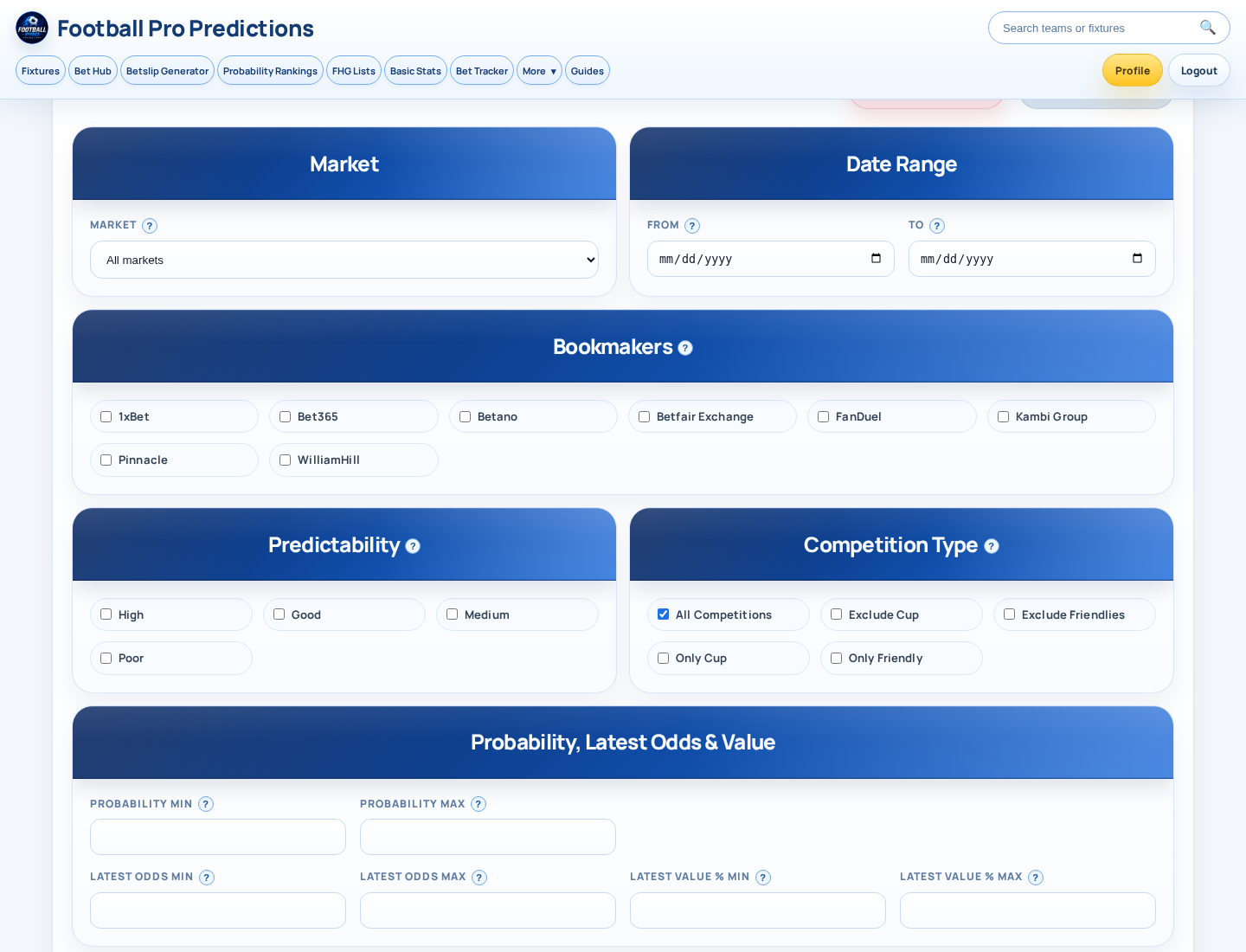
Go to [Value Bets Backtesting](/value-bets-backtesting). The archive provides filters for market, date range, bookmakers, predictability and competition type. It also provides minimum and maximum fields for probability, latest odds, latest value, opening odds, opening value and competition progress. A CSV download control is available for independent review. Translate your saved shortlist rules exactly. If the shortlist excludes cups and friendlies, apply the corresponding competition-type exclusions in the archive. If it limits bookmakers, markets, probability, odds, value or progress, reproduce those boundaries without adjustment. The backtesting interface shows a wider bookmaker list than the shortlist builder, so use only the bookmakers specified in the profile you are testing. The supplied interface text confirms the filtering controls but does not show the result fields returned after a completed query. Check your dashboard before stating that a particular output—such as strike rate, profit/loss, ROI, yield or drawdown—is available.
How to Read a Backtest Without Fooling Yourself
First, establish the number of settled bets in the query. A result based on a very small sample should not support a confident conclusion. Next, review profit/loss and ROI or yield if those metrics are displayed in your completed dashboard result. If a drawdown or period-by-period view is available, examine the worst downturn and whether outcomes were similar across separate time periods, markets and bookmakers. Strike rate and profitability are different questions. A strategy can have many winners but still perform poorly if its odds do not compensate for losing selections; conversely, a lower strike rate can coexist with a positive historical return. Neither pattern establishes future performance. A backtest becomes especially weak evidence when its filters were repeatedly altered after viewing the same data. Record each version, the date range used and every parameter.
Step 6: Run an Out-of-Sample Check
A simple workflow is to use an earlier date range to test the original hypothesis, then lock the parameters and inspect a later period you did not use to design the filter. If the later period differs materially, investigate the difference rather than repeatedly tuning the profile until it looks better. Keep an iteration log so that you can tell the difference between a pre-set hypothesis and a fitted result.
Step 7: Track Live Execution Separately
| Column | Why it matters |
|---|---|
| Strategy name and version | Identifies the exact rules in force. |
| Date and time checked | Captures timing and price movement. |
| Fixture and market | Makes each row identifiable. |
| Model probability, value and quoted odds | Records the displayed research signal. |
| Bookmaker and opening-price comparison | Shows the source and relevant price rule. |
| Stake, result and return | Separates actual outcomes from historical assumptions. |
| Notes and deviation reason | Records limits, unavailable odds, voids or rule breaks. |
Actual quoted odds can move before you act. Bookmaker availability, stake limits, voids and the treatment of exchange commissions can also make live execution differ from archived research. The supplied materials do not confirm how Betfair Exchange commissions are treated in historical data, so verify that point before comparing any archive result with an exchange-based record.
Common Beginner Mistakes
Responsible Use and Risk Controls
Frequently asked questions
Is every Football Pro Value Bet worth backing?
No. Football Pro explicitly labels the main Value Bets page as a raw research feed and warns against betting every unfiltered selection. Build and test a defined shortlist instead.
What does positive value mean?
It indicates that Football Pro’s model has identified a positive edge relative to the market odds displayed. It is model-dependent and is not certainty. The supplied interface text does not document the exact displayed Value formula.
Can a positive-value selection lose?
Yes. A positive-edge signal is an estimate about price relative to a model, not a prediction that an individual selection will win.
Which filters should I start with?
Start narrowly: choose markets, competition or fixture types, predictability labels, price and value boundaries, and bookmakers that you can explain. The example in this guide is illustrative, not a recommendation.
Why can my live odds differ from the backtest?
Odds can move, bookmakers can be unavailable, and real execution can be affected by limits, voids and other operational differences. Record the price and time actually observed.
How often should I change a strategy?
Do not change it after isolated wins or losses. Set the rules, test an earlier period, lock them, then review a later untouched period. Log every version.
Can I export backtest data?
The Value Bets Backtesting interface includes a Download CSV control. Check the live product for the exact export contents and any applicable access requirements.
Key Takeaways and Next Step
Key takeaways
- Read the main Value Bets board as a broad research feed, not a bet list.
- Write narrow rules before looking for favourable historical results.
- Save those rules as a Filtered Value Bets profile.
- Recreate the same filters in Value Bets Backtesting, including exclusions.
- Check an untouched later period before drawing conclusions.
- Keep a separate execution log and treat historical results as historical, not guaranteed future performance.
Sources and further reading
- Value Bets — Football Pro Predictions
- Filtered Value Bets — Football Pro Predictions
- Value Bets Backtesting — Football Pro Predictions
Put This Guide Into Practice
Use the live research tools to compare upcoming fixtures, probabilities and available prices. Always check current odds and stake responsibly.